

Introduction to kinematics
Concept Hook & Definition
Section titled “Concept Hook & Definition”Mechanics is the study of how objects move and interact with their surroundings. To build a solid foundation, classical mechanics divides the analysis of motion into two primary branches: kinematics and dynamics.
Kinematics is the mathematical description of motion without considering the forces that cause that motion. Often called the geometry of motion, kinematics provides the foundational vocabulary—position, displacement, velocity, and acceleration—needed to track where a body is and how its coordinates change through time.
Kinematics specifies how an object moves (its trajectory, speed, and acceleration). Dynamics investigates why it moves (the forces, energies, and interactions driving the motion).
The Particle Model
Section titled “The Particle Model”In the physical world, moving objects have complex shapes, internal vibrations, non uniformity etc. For example, a moving car has rotating wheels, vibrating engine pistons, roughness etc.
To make study of the body easy, we treat them as the idealized models. We treat an object as a single point having mass but having negligible volume or internal structure. This model is valid whenever:
- The dimensions of the object are negligible compared to the total distance it travels.
- The internal rotation or deformation of the object does not alter the translational path of its center of mass.
As a result, we can treat a football ball kicked as a point moving in its trajectory.
Relativity of Rest and Motion
Section titled “Relativity of Rest and Motion”A fundamental principle of physics is that rest and motion are strictly relative terms. There is no such thing as an absolute position or a body in absolute, universal rest. Motion can only ever be stated with respect to an observer or an established frame of reference.
A frame of reference consists of a coordinate axes system anchored to a chosen reference body, paired with a synchronized clock to record time.
Let denote the position vector of a body at time relative to a specific observer:
- At Rest: If as time advances, the body is at rest relative to that observer.
- In Motion: If varies with time, the body is in motion relative to that observer.
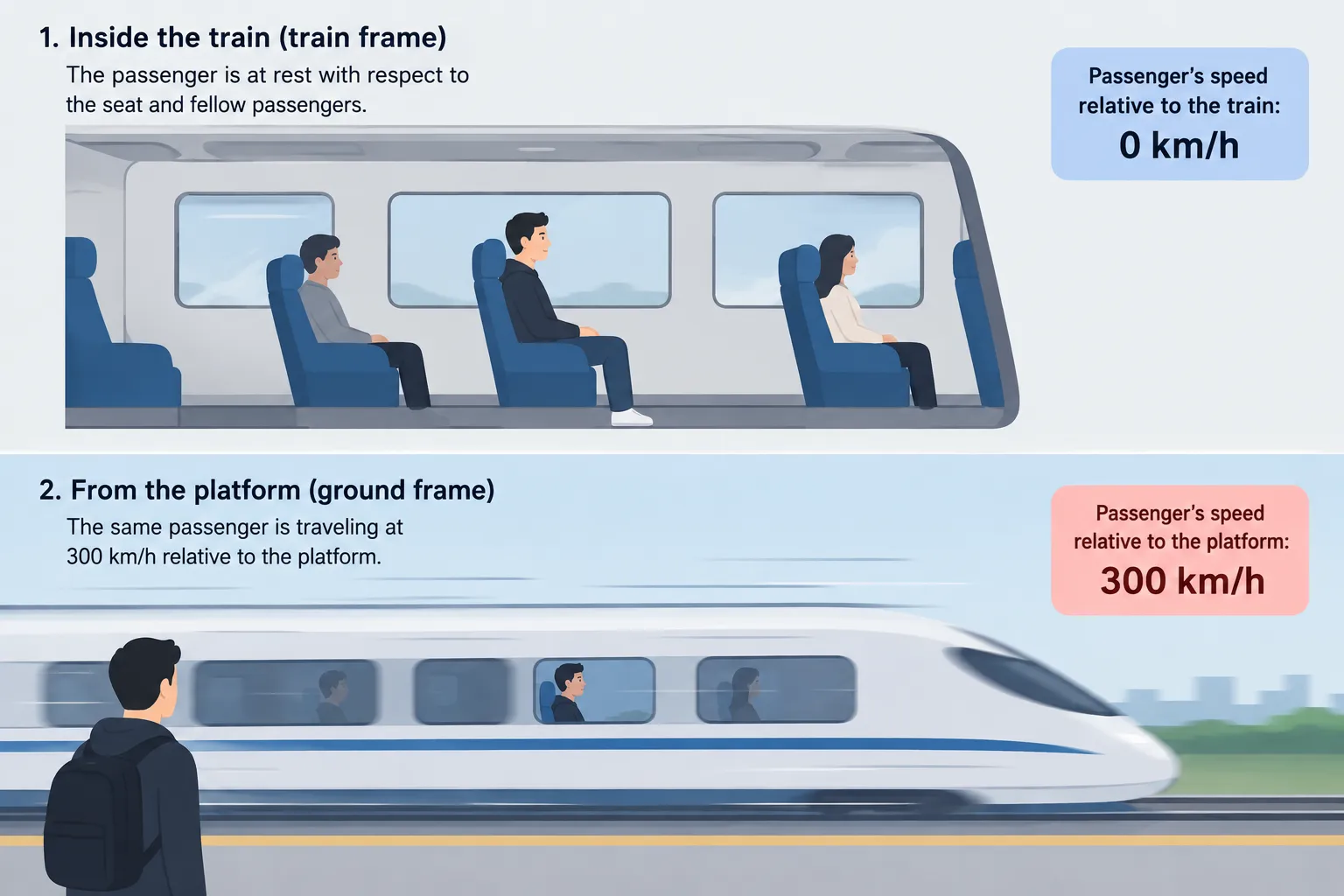
A passenger sitting inside a high-speed train car is completely at rest with respect to the seat and fellow passengers. Yet to an observer standing on the railway platform, that same passenger is traveling at 300 km/h. Both statements are entirely correct within their respective frames of reference.
We begin our quantitative study of kinematics in the following section by examining how to locate an object in space using Position.