

Position
Definition
Section titled “Definition”In mechanics, position denotes where a particle is in space. The position of a particle is defined with respect to the origin or with respect to the observer (usually at the origin). We can simply understand the position vector as a vector drawn from the origin to the point where the particle is located.
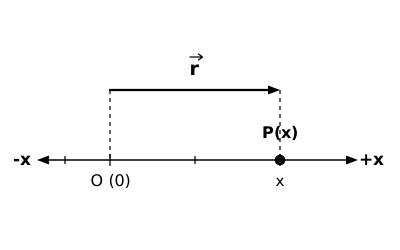
Figure 1: Position vector along 1D axis from origin to point .
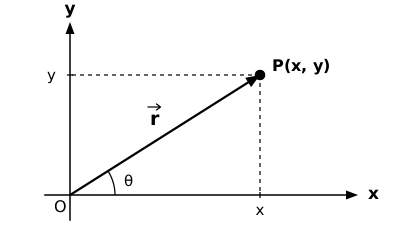
Figure 2: Position vector drawn from origin to point .
The SI unit of position is meter (), and its dimension is .
It is a vector quantity, meaning it requires both magnitude and direction to be defined. It is generally represented by (or in bold as ). The position of a particle can be defined either in 1 dimension, 2 dimensions or 3 dimensions. This chapter primarily focuses on motion in 1 dimension. We will discuss motion in different dimensions later.
3D Representation
Section titled “3D Representation”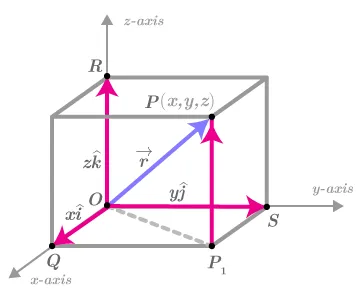
Figure 3: Position vector of point in a 3D Cartesian coordinate system.
The position vector of a particle in 3D is defined as:
The position of a particle has no absolute meaning if there is no coordinate system. If we change the coordinate system, the position vector of the particle also changes even if it is stationary with respect to the ground.
Magnitude
Section titled “Magnitude”The magnitude refers to the length of the vector or distance of the particle from the origin or from the observer. Given the coordinates of a particle with the observer at the origin, the magnitude (or length) of the position vector is calculated as:
But if the observer is not at the origin, the magnitude of the position vector relative to the observer is given by:
where are the coordinates of the particle and are the coordinates of the observer.